The one-line answer
Thermal sees heat; night vision sees light. They're not better or worse — they do different jobs.
Thermal
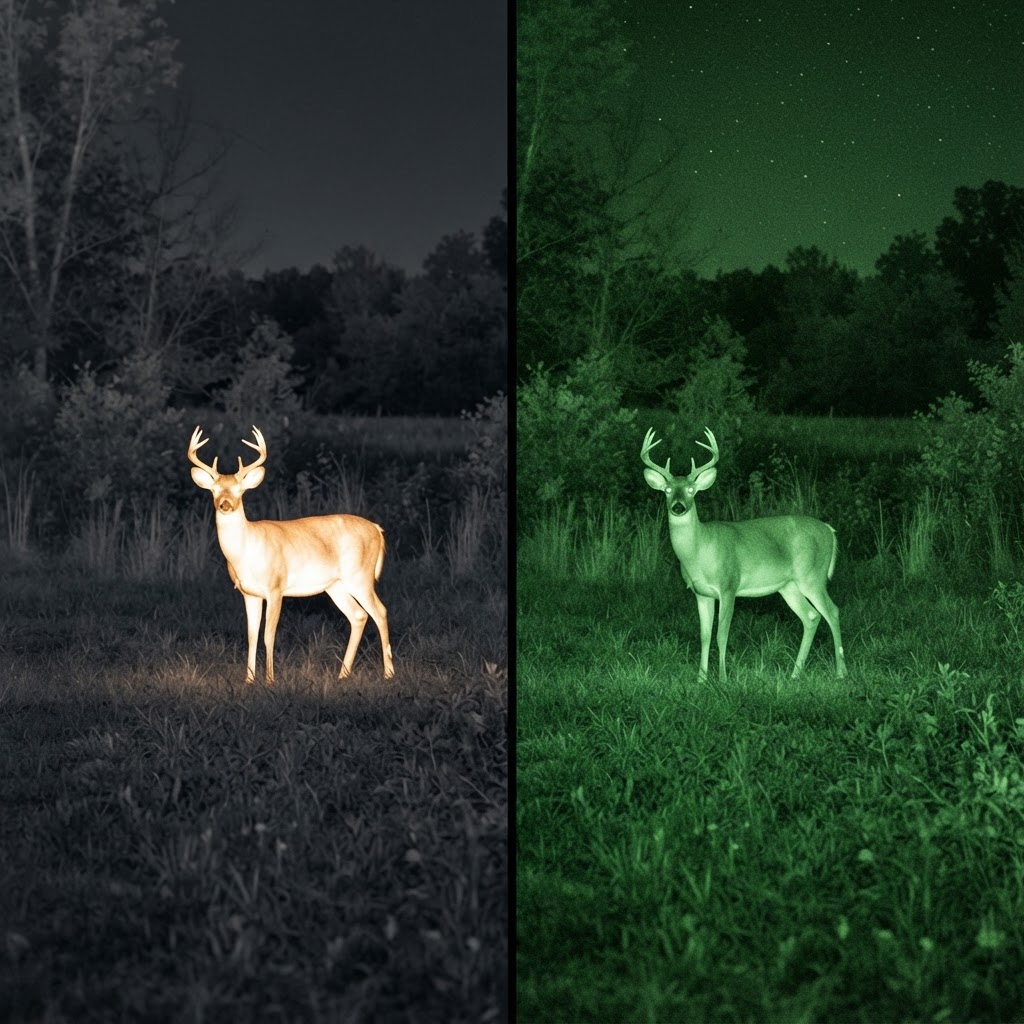
Thermal imaging detects the infrared radiation every warm object gives off and turns it into a picture. It works in total darkness, through light fog, smoke, and thin brush, and it will spot a living animal that's completely hidden from your eyes. It's unbeatable for detection — you will find animals you'd never see otherwise.
Where thermal is weaker: fine detail and identification at distance, and it can struggle in heavy rain or when everything is the same temperature (e.g., a flooded field on a warm night).
Night vision
Night vision amplifies available light — moonlight, starlight, ambient glow. It gives you a more natural image with recognizable detail and depth, and it's better for navigating and identifying at close-to-mid range. But it needs some light: in a pitch-black barn or under heavy canopy, a digital night vision device is near-useless, while thermal still works.
Which should you buy?
- Hog control, predator calling, search & rescue: thermal.
- General night observation, navigating, surveillance: night vision.
- Can't decide? A multispectral scope (thermal + NV in one unit, like the DNT ThermNight) gives you both.
For most Thermisight customers who hunt, thermal is the more transformative first purchase — it changes what you can find, not just how well you see.